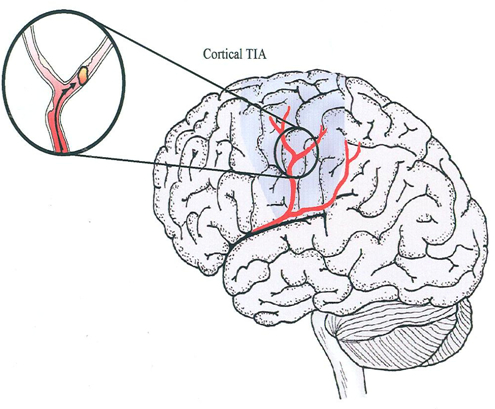
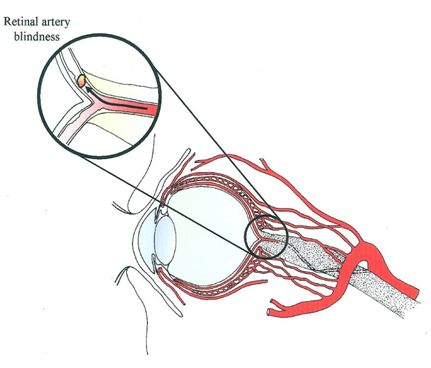
How does a carotid artery blockage produce stroke or visual field deficits?
In most cases the plaque producing the blockage may breakdown releasing particulate matter or clots that travel with the blood stream to block smaller arteries supplying the brain or retina ( Fig 2,3 respectively). The risk of stroke increases as more than one vessel is blocked. tThe most common location of blockage is the carotid artery in the neck.
About 20-30% of all strokes are attributed to significant ( > 50% ) blockage of the carotid arteries in the neck.
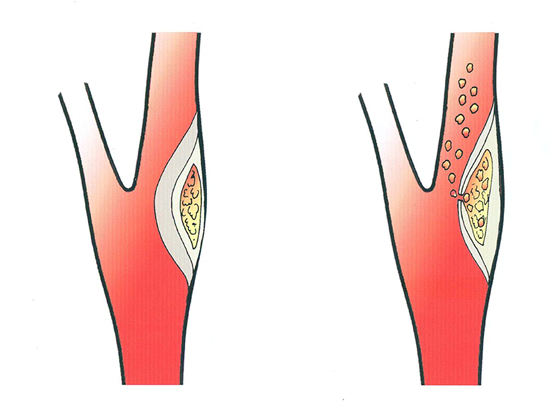
It is important to know that carotid plaques have varying structure. Some plaques are soft, inflamed and prone to breakdown and clot formation while others are hard, calcified and have a stable structure. Thus for a certain degree of narrowing one plaque may be unstable and prone to rupture or has ruptured releasing clots to the brain that produce a stroke ( Fig 4, right ) while another plaque is stable and likely to remain asymptomatic for the life of the patient (Fig 4,left))